
The Romans first came to this part of Spain in the late 3rd century when they defeated the Carthaginians and occupied the little city of Seville. Under Roman rule Seville grew rapidly in size and importance, so that by the time of Julius Caesar it occupied a large part of what is now the Casco Antiguo. He is regarded as one of the founders of the city because he built the first stone walls around it, and though these are long gone, the later Moorish walls followed the same course for much of their route.
In fact, although Seville (then known as Hispalis) was one of the great cities of Roman Spain, there are relatively few known physical remains from that period of the city’s history.
Doubtless there are plenty of potential archaeological discoveries still lurking beneath the streets and houses of the modern-day city.
Just outside the city centre, in Calle Luis Montoto, are two surviving sections of the aqueduct that supplied water to the city (there is a third beyond the shopping centre at Los Arcos). The original source of the water was near the modern village of Los Cercadillos de la Huerta de Santa Lucía, about 17km outside the city in the direction of Carmona, though only the last 4km of the channel was on an aqueduct. Most surprising is that the aqueduct did not disappear simply as a result of the passage of time, but was demolished in the early 20th century in an act of civic vandalism.
Hidden away in Calle Marmoles (Marbles street) in the Barrio Santa Cuz are three enormous pillars that are all that remains of a Roman temple, probably to the goddess Diana. The footings of the pillars appear to be sunk in a deep pit, but in fact it is the level of the ground around them that has risen over the centuries. Two more pillars were moved to the newly created Alameda de Hercules in the 16th century, and now stand at its western end, topped by statues of the city’s founders, Hercules and Julius Caesar. A sixth pillar is known to have been broken at this time as a result of attempts to move it.

Even more hidden away is the aljibe, or water cistern under the Plaza de la Pescadería. It’s still in a good state of preservation, but isn’t normally open to the public. It’s theoretically possible to look down into the structure through the “skylights” in the square, but in practice it’s either too dark, or there’s too much light reflecting off the glass.
Definitely worth visiting is the Antiquarium, the museum and archaeological site under the Metropol Parasols in Plaza de la Encarnación, featuring Roman and post Roman ruins, including some well-preserved mosaics. The remains were discovered when work began on an underground carpark for the planned new market building in the square.
There are also Roman remains in the lower levels of the archaeological excavations in the Patio de Banderas, and Roman stones with inscriptions that were reused in the foundations of the Giralda tower. There is also known to be a Roman bath house under the foundations of the Archbishop’s Palace.
Roman objects and mosaics, mostly from nearby Italica, can also be found at the Archaeological museum in María Luisa Park, and in the Palacio de Lebrija in Calle Cuna.


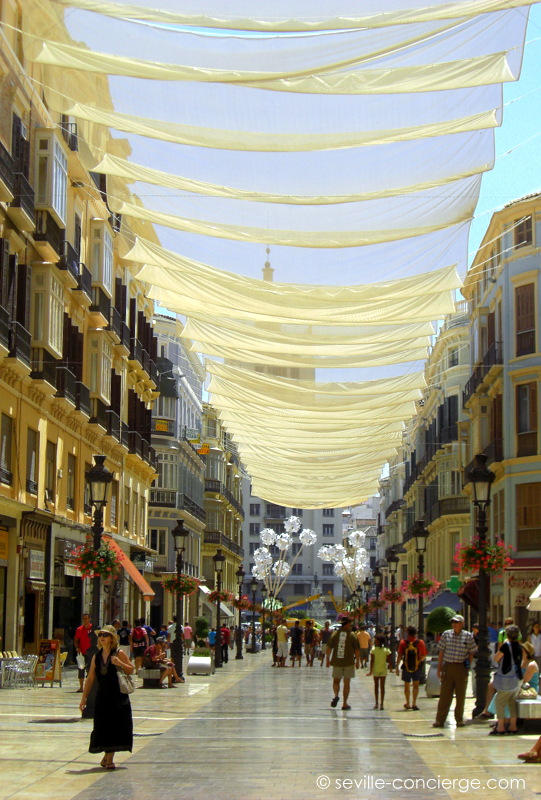


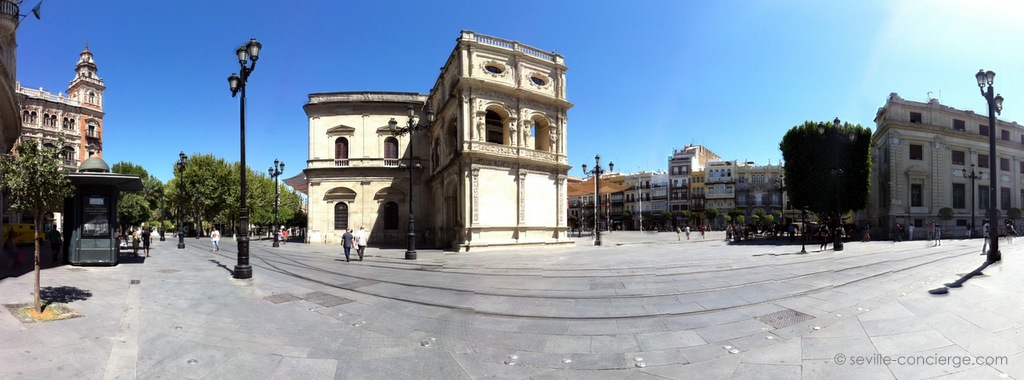
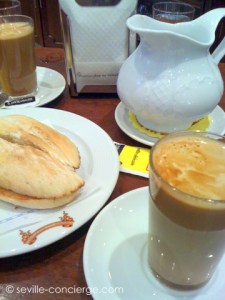 As the observant visitor to Seville will quickly notice, the day here has a different rhythm from what’s typical in either North America or the countries of Northern Europe. Most of the shops close for the afternoon, and then open again late into the evening, and the streets start to fill with people just when the guiris (foreigners) are heading home to bed. A lot of this has to do with the weather, of course. In summer (basically from April to October) it makes good sense to be out and about in the cool of the morning and the cool of the evening, and the consequent short nights and the afternoon heat means you really need that afternoon siesta.
 The main meal of the day is lunch (almuerzo), usually eaten between 2.00 and 4.00 pm. For working people who have to eat lunch out on a regular basis most tapas bars have a menu del día (a daily special), a two or three course meal with several options and usually including bread and a drink, costing between 6.50 and 12 euros. Don’t confuse the menu and the carta (main menu).
 Seville Concierge