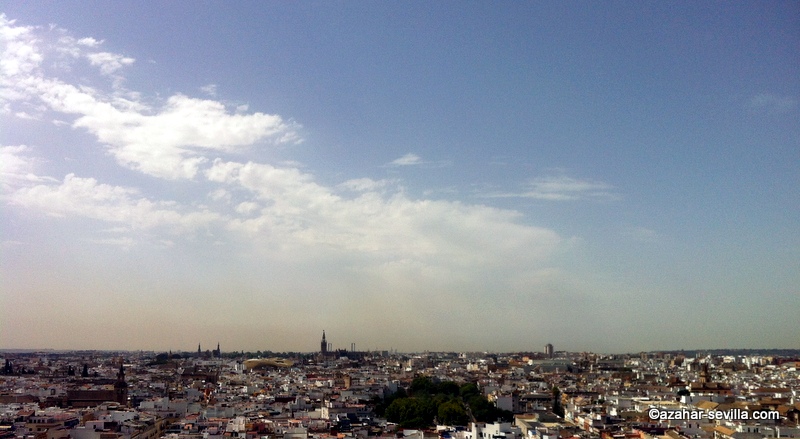
With the unusual luxury of an otherwise free morning the other day, I had the opportunity to take some time out to do one of my favourite things – exploring some of the more unusual and out of the way parts of Seville.
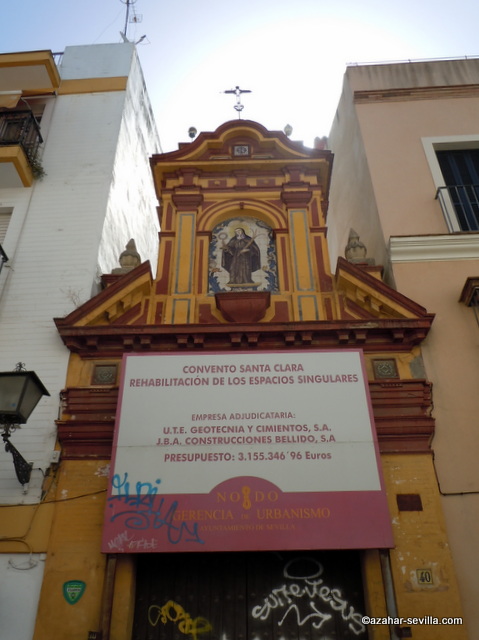
First port of call was the Espacio Santa Clara, the arts and culture centre that opened last year in the former convent of the same name after some six years of restoration work. That work is still ongoing, but sadly, only slowly, due to lack of funds. I’ve been fascinated by this building for a long time, as I pass the narrow, closed gate in Calle Santa Clara on a regular basis without being able to see inside.
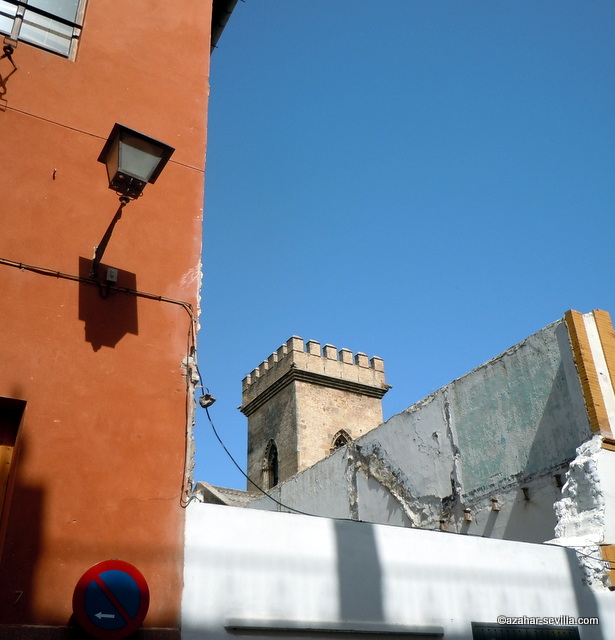
One thing I did know was inside was the first of my two towers, La Torre de Don Fadrique. It’s built in three stages in a style called Romano-Gothic, and surprisingly is the only example still standing. According to popular legend it was built about 1255 by the infante Frederick, brother of King Alfonso X, as a love-nest for his mistress, La Doña Juana, who was also his stepmother, the second wife of the previous king, Ferdinand III. The illicit romance was so unpopular that after three years Juana abandoned Seville and returned to France, with Frederick waving his last goodbye from the top of the tower as she set sail. My sources differ as to how much, if any, of this story is actually true. What is certain is that not long afterwards Frederick was executed by his brother, either for the offence against public decency, or, more likely, for treason against the crown.
Either way Frederick’s land around the tower was confiscated, and in 1289 was used for the founding of a Franciscan convent. The current building dates to the 16th and 17th centuries, and the grounds were once much more extensive, the peripheries being sold off to pay maintenance and running costs until the convent finally closed in the mid-20th century.
Unfortunately, when we arrived there was a notice on the door saying it was closed until the beginning of September, although on asking the man at the front desk it turned out this just meant that there were no exhibitions showing at the moment, and it was still possible to go into the central patio/cloister and the refectory. Although much of the rest of the building is still derelict, and it’s not possible to go into the orchard patio where the tower is, this area has been lovingly restored, and in September will be the venue for several concerts as part of the Biennal de Flamenco.
From Santa Clara we went to another tower with an interesting, but much shorter, history – La Torre de los Perdigones (The buckshot tower). This was built in the late 19th century as part of a munitions factory (closed in the fifties, and turned into a pretty little park a couple of decades later) and was used for making lead shotgun pellets. The lead was melted in a furnace at the top of the tower and dropped down the centre into a cooling lagoon to solidify them. We went up to the viewing platform just below the top to enjoy the wonderful views over the Cartuja and Macarena from a novel perspective. Although the narrowness of the platform at that height did give me a touch of vertigo, it was still a great experience, and goes to show that there’s more to Seville than just the Cathedral and the Alcázar.


 But that’s for later. My first stop after arriving is usually the Cathedral Plaza and my favourite pastry shop for some elevenses with a view. This is the oldest part of town, and apart from visiting the Cathedral, its worth going through the Arco de la Rosa and taking a stroll through the Barrio El Pópulo to the Roman amphitheatre, which was rediscovered entirely by accident in 1980.
 Further on are the fortifications of Santa Catalina Castle, built to protect the city in the 17th century. The little turrets that you see dotted around the seafront are called baluartes, and are a distinctive feature of the city. Also here is the Parc Genovés, a botanical garden with many species brought over from the Americas. This is a fascinating place, with an artificial cataract and the strange topiary of the trees on the main path.
 Having started the Seville Concierge blog on June 21st, the longest day of the year, it seems appropriate to start things off with a post about The Heat in Seville. The three months from mid-June to mid-September really do get hot (100ºF is common) and you do need to adapt your behaviour to deal with it. The standard advice you already know – drink lots of water, put on sun block, wear loose clothes and stay in the shade – but you’ll also want some things to do that keep you out of the midday sun.
 Cold beer. Cruzcampo’s Glacial beer is served at -2ºC and will slake your thirst like nothing else.
 Once evening hits make it over to one of Seville’s rooftop bars, and upgrade to a cocktail. The EME hotel and the Doña Maria are the most obvious, but show you know what’s what by going to the Hotel Inglaterra in the Plaza Nueva, or my personal favourite, the Fontecruz in Calle Abades, which has the coolest ambience as well as the best views. Cheers!
 Seville Concierge