Plaza Nueva and Plaza San Francisco

One of the recurring themes of my interest in Seville is the visual imagination of how the city has changed over the centuries. Because Seville has such a well-preserved centre, with many buildings of great antiquity, it is easy to forget that it didn’t always look the way it does now. Even a bit.

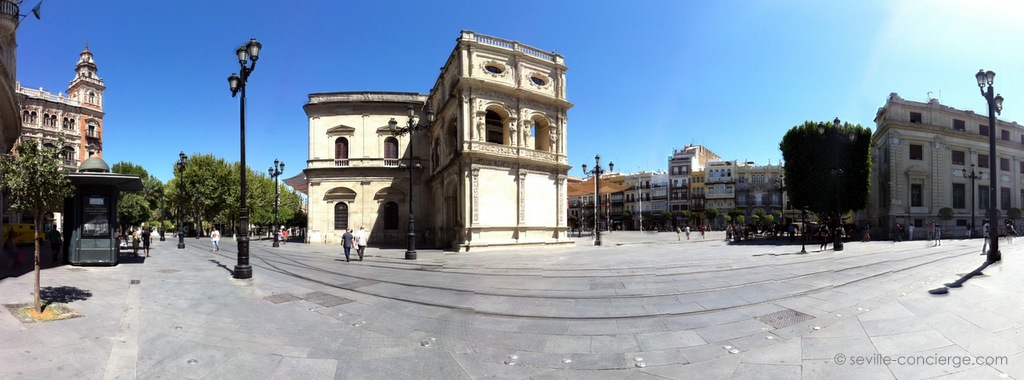
Stand, if you will, at the end of the Avenida de la Constitución, with the Plaza San Francisco on your right, and the Plaza Nueva in front of you, and imagine the scene a thousand years ago. The first thing you notice is that the city walls are behind you, and that there is a small lake in front of you, fed by a branch of the main river running down what is now Calle Sierpes and on into the Arenal. Down to the river is just fields and trees, subject to surprisingly frequent floods. Not for another 150 years will the walls be extended to where we think of them today, much nearer the river. In the space inside the walls behind us, the new Grand Mosque and its minaret, which will later become the Giralda Tower, appear. After the reconquest of 1248, it will be replaced in turn by the Christian cathedral.

There are other changes going on too. Houses have been built to your left, and the lake has been drained. In its place monks have started work on what will become the “Casa Grande” of the Franciscans, which will soon give its name to the open space in front of it – the Plaza San Francisco. The monastery itself will come to occupy the whole of what is now Plaza Nueva and the streets beyond and to either side.

1492, and Columbus has discovered America. With a monopoly on trade with the new world, Seville is rapidly becoming rich. As symbols of its wealth the city acquires a new civic centre around the Plaza San Francisco. A new town hall (ayuntamiento) is built in front of the Casa Grande (the archway on the end of the town hall is the original main entrance to the monastery), followed a few decades later by the Antigua Audiencia (the justice house, now the Cajasol bank building). If you’re unlucky you may see the autos de fé of the inquisition during this and the following century.

The Casa Grande, badly damaged by a fire and general neglect in the Napoleonic era, is finally demolished in the 1840s, the resulting space becomes the Plaza Nueva, and the town hall is given a new facade. But even now there are big changes to come. What is now the Avenida de la Constitución, is still a typical narrow Seville street, but in the early years of the twentieth century it is widened into the modern wide, straight street we see today, familiar buildings like the circular “wedding cake buiding”, the Adriatico, and the Banco de España are built and the first cars and trams appear.

Finally, just a few years ago the whole area was pedestrianised and repaved, and the new tramway installed, resulting in the cityscape we see today.
The Two Towers

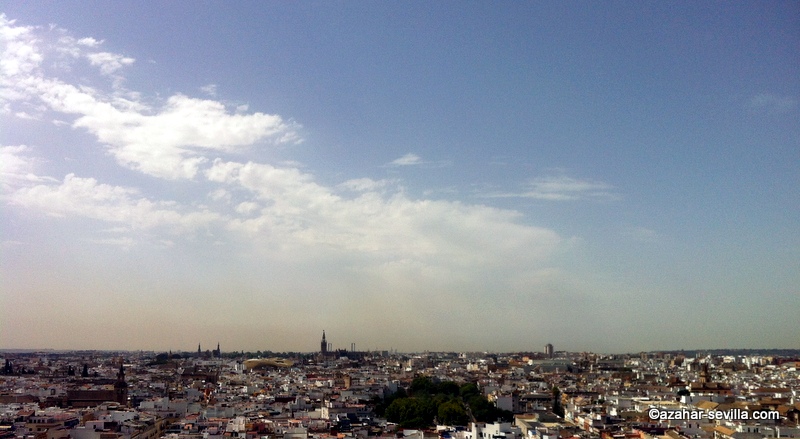
view from the Torre de los Perdigones

With the unusual luxury of an otherwise free morning the other day, I had the opportunity to take some time out to do one of my favourite things – exploring some of the more unusual and out of the way parts of Seville.

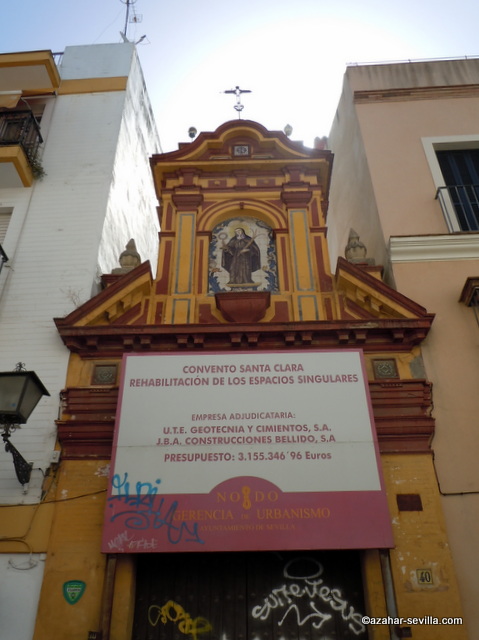
First port of call was the Espacio Santa Clara, the arts and culture centre that opened last year in the former convent of the same name after some six years of restoration work. That work is still ongoing, but sadly, only slowly, due to lack of funds. I’ve been fascinated by this building for a long time, as I pass the narrow, closed gate in Calle Santa Clara on a regular basis without being able to see inside.

original entrance of Santa Clara convent

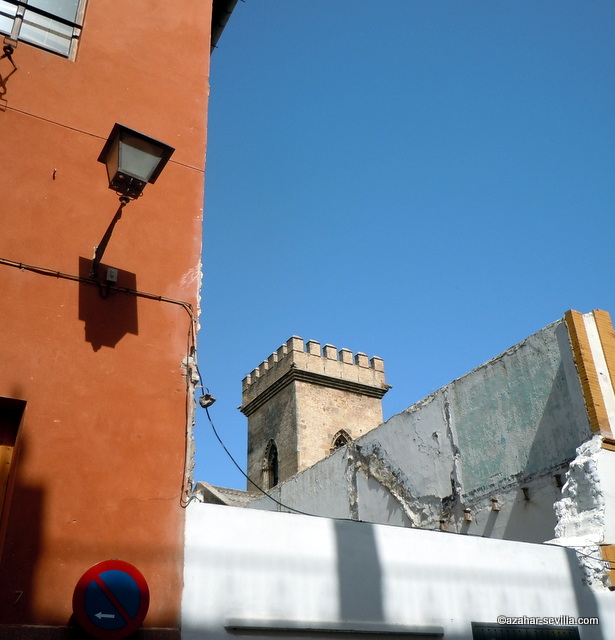
One thing I did know was inside was the first of my two towers, La Torre de Don Fadrique. It’s built in three stages in a style called Romano-Gothic, and surprisingly is the only example still standing. According to popular legend it was built about 1255 by the infante Frederick, brother of King Alfonso X, as a love-nest for his mistress, La Doña Juana, who was also his stepmother, the second wife of the previous king, Ferdinand III. The illicit romance was so unpopular that after three years Juana abandoned Seville and returned to France, with Frederick waving his last goodbye from the top of the tower as she set sail. My sources differ as to how much, if any, of this story is actually true. What is certain is that not long afterwards Frederick was executed by his brother, either for the offence against public decency, or, more likely, for treason against the crown.

Either way Frederick’s land around the tower was confiscated, and in 1289 was used for the founding of a Franciscan convent. The current building dates to the 16th and 17th centuries, and the grounds were once much more extensive, the peripheries being sold off to pay maintenance and running costs until the convent finally closed in the mid-20th century.

top of the Don Fadrique tower seen from street

Unfortunately, when we arrived there was a notice on the door saying it was closed until the beginning of September, although on asking the man at the front desk it turned out this just meant that there were no exhibitions showing at the moment, and it was still possible to go into the central patio/cloister and the refectory. Although much of the rest of the building is still derelict, and it’s not possible to go into the orchard patio where the tower is, this area has been lovingly restored, and in September will be the venue for several concerts as part of the Biennal de Flamenco.

From Santa Clara we went to another tower with an interesting, but much shorter, history – La Torre de los Perdigones (The buckshot tower). This was built in the late 19th century as part of a munitions factory (closed in the fifties, and turned into a pretty little park a couple of decades later) and was used for making lead shotgun pellets. The lead was melted in a furnace at the top of the tower and dropped down the centre into a cooling lagoon to solidify them. We went up to the viewing platform just below the top to enjoy the wonderful views over the Cartuja and Macarena from a novel perspective. Although the narrowness of the platform at that height did give me a touch of vertigo, it was still a great experience, and goes to show that there’s more to Seville than just the Cathedral and the Alcázar.

La Monumental

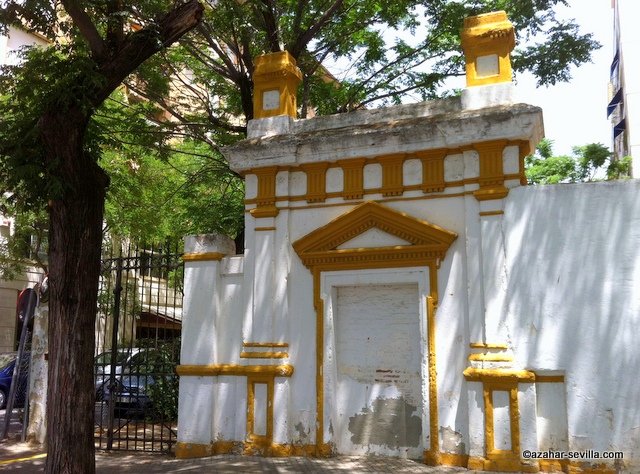
remaining gate of La Monumental

Halfway up Avenida Eduardo Dato, on the corner of Calle Diego Angulo Iñiguez opposite the Buhaira Palace Gardens, stands a short section of apparently functionless wall with a bricked up doorway to a small vacant lot. There’s no plaque, no sign, nothing to say that this is all that remains of the Plaza de Toros Monumental de Sevilla, the city’s ill-fated second bullring, first opened to the public in 1918, closed in 1921, and finally demolished in 1930. The driving force behind its construction was the famous bullfighter José Gómez Ortega ‘Gallito’, also known as Joselito, whose death in the ring on May 16, 1920, was a contributory factor in its closing. In 1915, when construction started, this was a ‘greenfield’ site a short way outside the city. Demolition made way for the new suburbs that now spread out to Nervion and beyond. I knew of the existence of the Monumental before I discovered this, but even such a small piece of its actual physical presence makes it much more real.

The architects were José Espiau y Muñoz and Francisco Urcola Lazcanotegui, whose other works include the Hotel Alfonso XIII, and the Adriática at the end of Avenida Constitución.

La Monumental tapas bar is located on the old site and is filled with bullfighting memorabilia including framed contemporary newsclippings about Seville’s forgotten bullring.