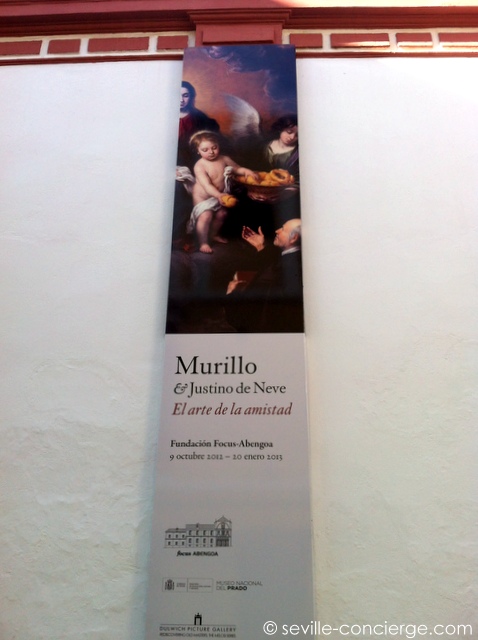
This year is the 400th anniversary of the birth of Bartolome Murillo, probably Sevilla’s most famous painter, and has been officially declared the Year of Murillo. As part of the commemorations the Fundación Focus-Abengoa, in collaboration with the Prado Museum, London’s National Gallery, and others, has organised a very special exhibition comparing the work of Murillo and Sevilla’s other most famous painter, Diego Velázquez.
 The two painters, born in Seville a generation apart (Velazquez in 1599 and Murillo in 1617), and having their formative influences there, nevertheless had quite different career trajectories, Velazquez leaving Seville to work at the Spanish court in Madrid in 1623, while Murillo spent his entire working life in Seville. It’s not known whether the two ever actually met in person (though they must have been aware of each others’ work), but while there is no record of a meeting, it’s not impossible as Murillo visited Madrid on several occasions, although art experts think that there was only limited reciprocal influence.
 Santa Rufina by Murillo (left) and Velázquez (right)
However, it’s clear from the 19 paintings in the exhibition, 10 by Murillo and 9 by Velázquez, that there were common influences in the cultural world of Sevilla in the 17th century. This shows itself in both the choice (or commissioning) of subjects, especially in religious subjects pertaining to Sevilla such as the Saints Justa and Rufina and the Immaculate Conception, as well as of Saint Peter and the Adoration of the Magi, and the highly naturalistic style of the scenes of everyday life.
 Everyday scenes by Velázquez (left) and Murillo (right)
It’s also appropriate that the exhibition is being hosted in the Venerables Hospital, a building that is of the early 17th century, and which has both a historical and current associations with the two painters. Around mid-January the exhibition, which continues until February 28th, surpassed the 50,000 visitor mark.
Velásquez | Murillo | Sevilla
Hospital de los Vernerables
Plaza de los Venerables 8
Open 10.00 – 18.00 (last entrance at 17.30)
General Admission: 8 euros
Free Admission Tuesday 14.00 – 18.00
 hall, the Casa Consistorial (1527-1564), usually known as the Ayuntamiento, with its ornate plateresque decoration and the arcade that gave access to the Franciscan friary which occupied the whole of what is now Plaza Nueva. In the later years of the century the Real Audencia, a court of the Castilian crown, was built on the other side of the Plaza San Francisco, with the Royal Prison on the corner of Sierpes street (the site is now occupied by a bank). Miguel de Cervantes, who wrote Don Quixote, was for a short time “a guest of His Majesty” here.
 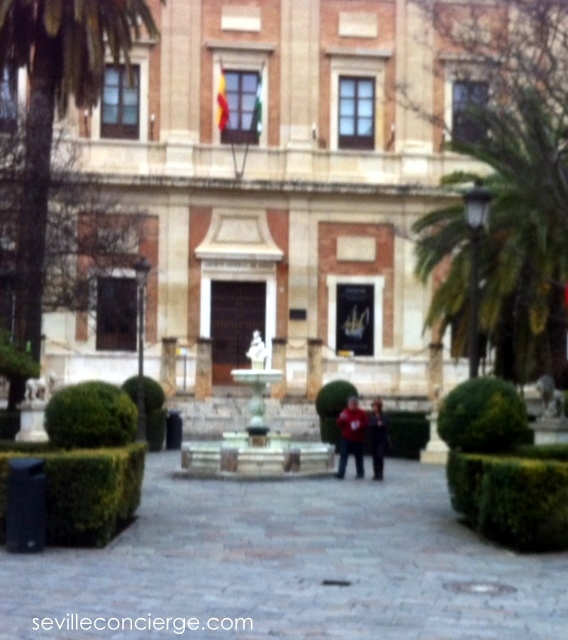 From the same period are the Archivo General de Indias, built originally as the Casa Lonja or commodities exchange, and now the third of Seville’s World Heritage buildings, the Casa Moneda (Royal Mint), where silver from the New World was minted into coin, and the Hospital de Cinco Llagas (the Five Wounds), which is now the home of the Andalucian Parliament. At the same time many churches, monasteries and convents, as well as private palaces of the aristocracy and merchants all over the city were built or elarged.


 Seville Concierge