Vikings

It’s early morning, and behind the city walls the population is stirring, but today will not be like every other day. As the dawn mist burns off the river the long, sleek, high-prowed ships can be seen rapidly approaching…
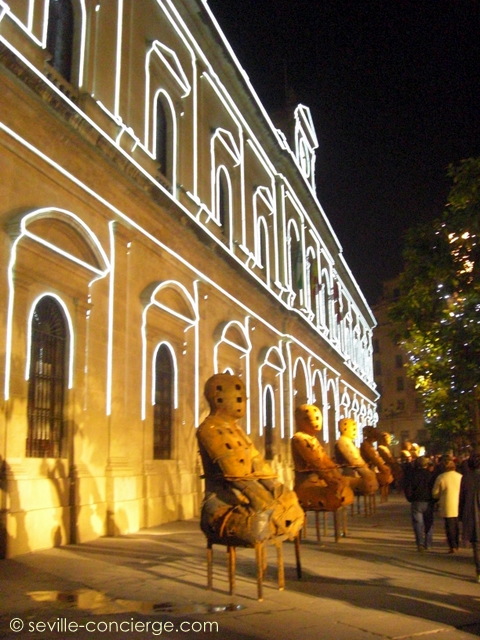
One of the things that I love about Seville is that no matter how much I learn there always seems to be something new to discover about the people and places that make the city what it is. A few years ago I passed an art exhibition in the Plaza Nueva, which included a slightly abstract model of a longboat. At the time I didn’t realise its significance, which is why the boat itself isn’t in this photo, but it turns out that in the 9th century the Vikings twice raided Seville, in 844 when they sacked the city, and again in 859. One legacy of these raids was a Viking longship that was found in the Plaza Nueva during the digging of a test shaft in connection with the new metro. The 844 raid involved some fierce fighting, and it may have been left behind for lack of sufficient crew.

At first sight the Plaza Nueva may seem an odd place for a longship to end up, but we know that at this time there was a side branch of the Guadalquivir River that ran from what is now the Alameda, past Campana, along Sierpes, across the end of Plaza Nueva, and into the main river between the Torre del Oro and the Triana Bridge (none of these existed then, of course), and that this was outside the city walls as they were then, and it’s quite logical that the boats would have been beached there. I’ve often wondered what happened to the boat they found.
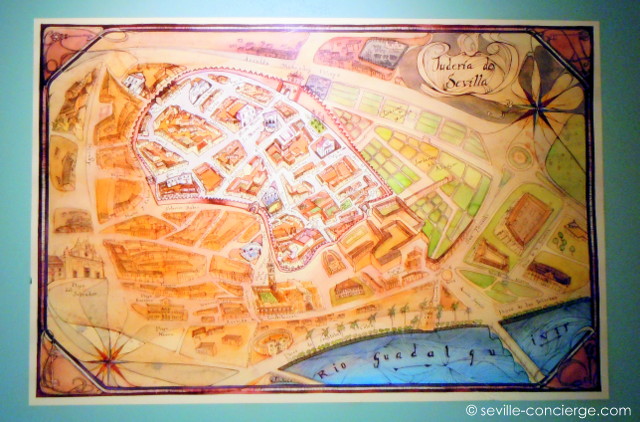
The Judería of Seville

Seville’s most picturesque and first-destination-for-tourists neighbourhood, the Barrio Santa Cruz, is equally well known as the old Jewish quarter, but the history and importance of the Jews in Spain (the Sephardim) are underestimated or even unknown to a majority of Western Europeans. It’s not known when Jews first came to Spain (it may have been as long as 3,000 years ago), but it was under the Romans in the early centuries AD that their numbers became substantial, and remained so until the late 15th century, when they were finally expelled by the Catholic Kings.

Although they were always second-class citizens, and their relations with the majority populations had many ups and downs, the Spanish Jews generally enjoyed more freedom than Jews elsewhere, and while most were ordinary workers and artisans, a few became wealthy and influential and others were prominent in the intellectual life of society. The interplay of diverse cultures in southern Spain during this time made it the centre of civilisation in Europe, and gave the Sephardic Jews a distinct identity of their own, and for these reasons it is regarded as a “golden age” in their history, and their expulsion is still felt as a great loss and sadness.

After the reconquest of Seville by Ferdinand III in 1248, the Jews here (the second largest Jewish community in Spain after Toledo) had their own quarter in the Santa Cruz, surrounded by a wall with several gates, and for about a hundred years they co-existed peacefully with the Christian population. Then, in the general turmoil and paranoia after the Black Death (1348-1350), persecution of the Jews increased, culminating in the pogrom of 1391. After that many Jews fled, or were forced to convert to Christianity. With the establishment of the Inquisition in 1478, and the formal expulsion of the Jews in 1483, the history of the Jews in Seville came to its tragic end.

The new Centro de Interpretación de la Judería de Sevilla is Seville’s first museum of the history and achievements of Seville’s Jews, telling their story in words (Spanish with English translations) and pictures and other exhibits.

Ximénez de Enciso, 22
Tel: 954 047 089
Daily 10.30-14.00 and 17.30–20.00
Entrance €6.50
Website

The Cervantes Plaques

If you are walking around Seville, and keeping your eyes open for the unexpected, you may see a plaque like this one.

Miguel de Cervantes Saavedra is the Spanish equivalent of Shakespeare (and by one of those strange quirks of history, they both died on the same day, April 22, 1616), and everybody is at least aware of the tale of Don Quixote, and the images of the gallant knight tilting at windmills, his squire Sancho Panza and his bony horse. His other works are less well known, but many of the short stories in his Novelas Ejemplares were written while he was living in Seville, including a short stay as a guest of his majesty in the Royal Prison, and the plaques commemorate places around the city that were mentioned by him in the stories. There are seventeen altogether, mostly in the centre, but including one in Triana, and another in the gardens of the Buhaira.

How many can you find?

A full list (in Spanish) can be found here.

Plaza Nueva and Plaza San Francisco

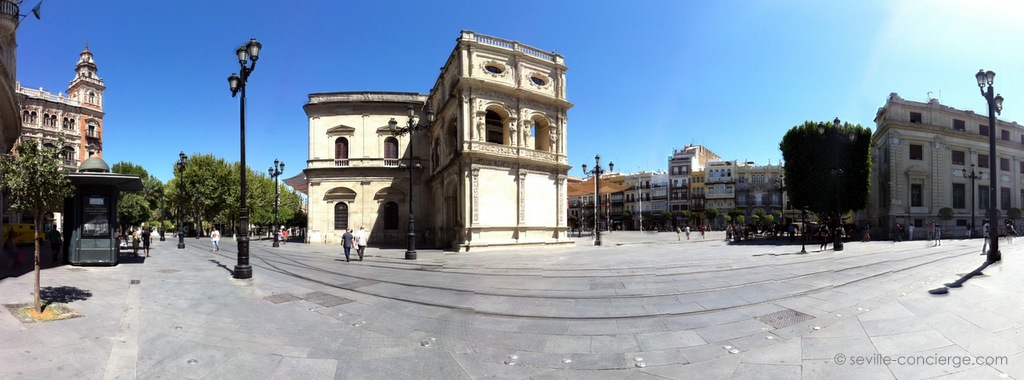
One of the recurring themes of my interest in Seville is the visual imagination of how the city has changed over the centuries. Because Seville has such a well-preserved centre, with many buildings of great antiquity, it is easy to forget that it didn’t always look the way it does now. Even a bit.

Stand, if you will, at the end of the Avenida de la Constitución, with the Plaza San Francisco on your right, and the Plaza Nueva in front of you, and imagine the scene a thousand years ago. The first thing you notice is that the city walls are behind you, and that there is a small lake in front of you, fed by a branch of the main river running down what is now Calle Sierpes and on into the Arenal. Down to the river is just fields and trees, subject to surprisingly frequent floods. Not for another 150 years will the walls be extended to where we think of them today, much nearer the river. In the space inside the walls behind us, the new Grand Mosque and its minaret, which will later become the Giralda Tower, appear. After the reconquest of 1248, it will be replaced in turn by the Christian cathedral.

There are other changes going on too. Houses have been built to your left, and the lake has been drained. In its place monks have started work on what will become the “Casa Grande” of the Franciscans, which will soon give its name to the open space in front of it – the Plaza San Francisco. The monastery itself will come to occupy the whole of what is now Plaza Nueva and the streets beyond and to either side.

1492, and Columbus has discovered America. With a monopoly on trade with the new world, Seville is rapidly becoming rich. As symbols of its wealth the city acquires a new civic centre around the Plaza San Francisco. A new town hall (ayuntamiento) is built in front of the Casa Grande (the archway on the end of the town hall is the original main entrance to the monastery), followed a few decades later by the Antigua Audiencia (the justice house, now the Cajasol bank building). If you’re unlucky you may see the autos de fé of the inquisition during this and the following century.

The Casa Grande, badly damaged by a fire and general neglect in the Napoleonic era, is finally demolished in the 1840s, the resulting space becomes the Plaza Nueva, and the town hall is given a new facade. But even now there are big changes to come. What is now the Avenida de la Constitución, is still a typical narrow Seville street, but in the early years of the twentieth century it is widened into the modern wide, straight street we see today, familiar buildings like the circular “wedding cake buiding”, the Adriatico, and the Banco de España are built and the first cars and trams appear.

Finally, just a few years ago the whole area was pedestrianised and repaved, and the new tramway installed, resulting in the cityscape we see today.

Eating times in Seville

As the observant visitor to Seville will quickly notice, the day here has a different rhythm from what’s typical in either North America or the countries of Northern Europe. Most of the shops close for the afternoon, and then open again late into the evening, and the streets start to fill with people just when the guiris (foreigners) are heading home to bed. A lot of this has to do with the weather, of course. In summer (basically from April to October) it makes good sense to be out and about in the cool of the morning and the cool of the evening, and the consequent short nights and the afternoon heat means you really need that afternoon siesta.

This Mediterranean timetable also affects the times that people normally eat meals. Naturally this varies a bit from person to person according to circumstance, as it does anywhere, but there are some regularities. Meals are generally eaten later here than in northern Europe.

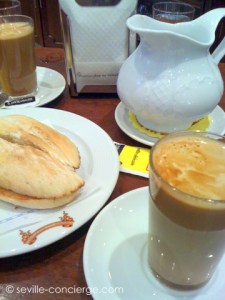
Breakfast (desayuno) is often not much more than coffee and a quick bite, eaten at home, and equally often is repeated in a bar or café around 10.00 – 10.30 am (so not the best time to go to the post office or bank). For children a typical breakfast would be cola-cao (a chocolate milk drink) and a sweet roll or magdalena, a typical Spanish cake. The famous churros and chocolate will usually be reserved for weekends (it’s a great hangover cure).

The main meal of the day is lunch (almuerzo), usually eaten between 2.00 and 4.00 pm. For working people who have to eat lunch out on a regular basis most tapas bars have a menu del día (a daily special), a two or three course meal with several options and usually including bread and a drink, costing between 6.50 and 12 euros. Don’t confuse the menu and the carta (main menu).
It’s common to fill in the gap between lunch and dinner with a merienda, the Spanish equivalent of the now sadly almost defunct English high tea. This takes place between 5.00 – 7.00 pm and is typically a light snack, or more often, a cake with coffee.

Dinner (cena) tends to be a lighter meal and starts around 8.00 in the evening, or even later if you’re eating out. At home this will be something like an omelette, or maybe some soup or salad. If you’re out with family or friends, tapas is the name of the game. For most people full restaurant meals will be for special occasions only.

Opening Hours:
Tapas bars and restaurants are usually open from 1.00 to about 4.00, and again from 8.00 to about 11.30. Some will stay open all day but few have all-day kitchens, other than very touristy places. If you stick to earlier mealtimes than what’s normal locally the bars won’t be busy when you arrive, and if they get busy later you’ll already have the best seats.

For more about tapas and tips on how to order them, take a look at Tapas 101.

The Two Towers

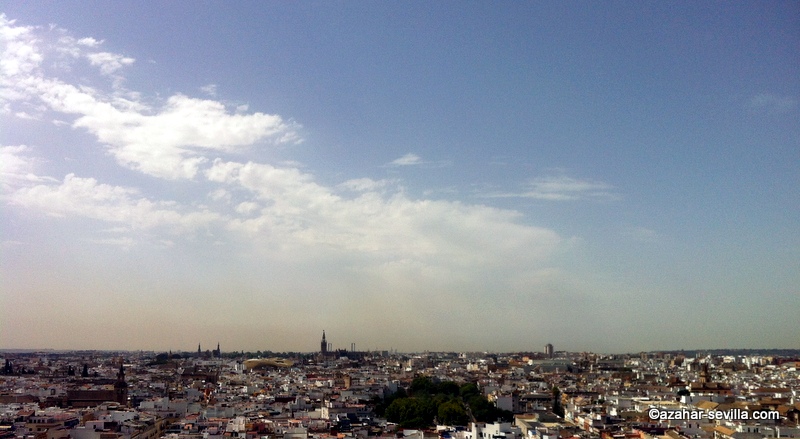
view from the Torre de los Perdigones

With the unusual luxury of an otherwise free morning the other day, I had the opportunity to take some time out to do one of my favourite things – exploring some of the more unusual and out of the way parts of Seville.

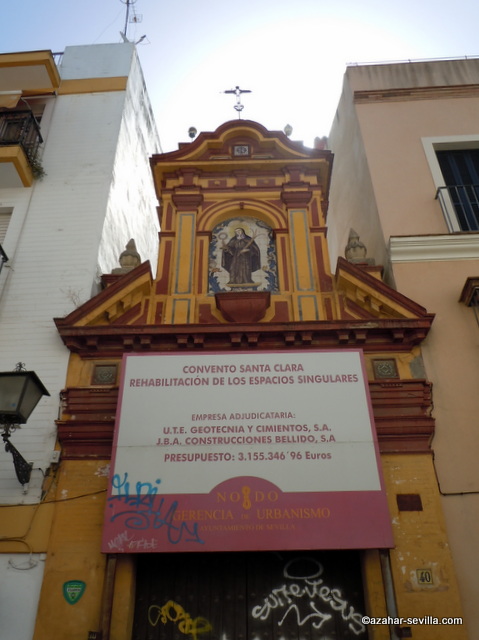
First port of call was the Espacio Santa Clara, the arts and culture centre that opened last year in the former convent of the same name after some six years of restoration work. That work is still ongoing, but sadly, only slowly, due to lack of funds. I’ve been fascinated by this building for a long time, as I pass the narrow, closed gate in Calle Santa Clara on a regular basis without being able to see inside.

original entrance of Santa Clara convent

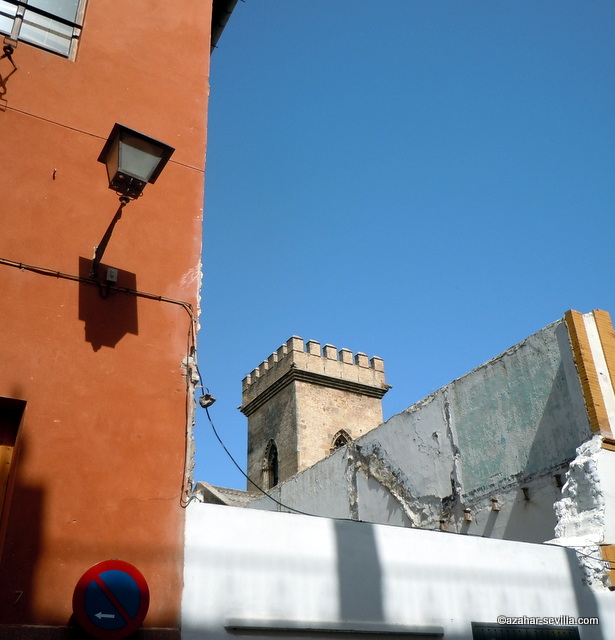
One thing I did know was inside was the first of my two towers, La Torre de Don Fadrique. It’s built in three stages in a style called Romano-Gothic, and surprisingly is the only example still standing. According to popular legend it was built about 1255 by the infante Frederick, brother of King Alfonso X, as a love-nest for his mistress, La Doña Juana, who was also his stepmother, the second wife of the previous king, Ferdinand III. The illicit romance was so unpopular that after three years Juana abandoned Seville and returned to France, with Frederick waving his last goodbye from the top of the tower as she set sail. My sources differ as to how much, if any, of this story is actually true. What is certain is that not long afterwards Frederick was executed by his brother, either for the offence against public decency, or, more likely, for treason against the crown.

Either way Frederick’s land around the tower was confiscated, and in 1289 was used for the founding of a Franciscan convent. The current building dates to the 16th and 17th centuries, and the grounds were once much more extensive, the peripheries being sold off to pay maintenance and running costs until the convent finally closed in the mid-20th century.

top of the Don Fadrique tower seen from street

Unfortunately, when we arrived there was a notice on the door saying it was closed until the beginning of September, although on asking the man at the front desk it turned out this just meant that there were no exhibitions showing at the moment, and it was still possible to go into the central patio/cloister and the refectory. Although much of the rest of the building is still derelict, and it’s not possible to go into the orchard patio where the tower is, this area has been lovingly restored, and in September will be the venue for several concerts as part of the Biennal de Flamenco.

From Santa Clara we went to another tower with an interesting, but much shorter, history – La Torre de los Perdigones (The buckshot tower). This was built in the late 19th century as part of a munitions factory (closed in the fifties, and turned into a pretty little park a couple of decades later) and was used for making lead shotgun pellets. The lead was melted in a furnace at the top of the tower and dropped down the centre into a cooling lagoon to solidify them. We went up to the viewing platform just below the top to enjoy the wonderful views over the Cartuja and Macarena from a novel perspective. Although the narrowness of the platform at that height did give me a touch of vertigo, it was still a great experience, and goes to show that there’s more to Seville than just the Cathedral and the Alcázar.

Velá de Triana

The Velá de Triana, or Velá de Santiago y Santa Ana to give it its full and correct title, is a traditional market fair that dates back to the 13th century, and is Triana’s largest annual street party. It’s held in late July, (this year July 20-July 26) and draws large crowds from all over the city.

There’s a stage for concerts in the Plaza del Altozano, local associations and hermandades set up booths and stalls along Calle Betis, and there is a small funfair for children towards the San Telmo Bridge, There are lots of activities during the week, including concerts, rowing and fishing competitions, an exhibition of old photographs in the Castillo San Jorge, and the Cucaña (which I finally saw for the first time this year), where the contestants (mostly young men, but some women, too) get a chance to show off by snatching a flag from the end of a greasy pole projecting over the river.

It’s a great way to spend a summer evening or two, strolling beside the booths, drinking beer or a sherry, and sampling the pescaito frito (fried fish) and green hazelnuts. The alumbrado, the switching on of the lights on Triana Bridge, took place at midnight on the Friday, and this year the festival ends with a flamenco performance in the Plaza del Altozano at 10.30 on Thursday evening. Maybe see you there?

Seville Concierge Goes To The Movies

Seville’s grand and exotic architectural masterpieces have led to it being chosen as the location for a number of famous films. Here we see Anakin and Padme in the grounds of the palace on the planet of Naboo (Star Wars Episode II: Attack of the Clones) This visually stunning film set is actually the colonnade of the Plaza España, built for the 1929 Spanish-American Exhibition.

The Plaza was also featured as British HQ in the Cairo Hotel in David Lean’s film of Lawrence of Arabia (starring Peter O’Toole), and more recently as the Palace of Wadiya in Sacha Baron Cohen’s The Dictator.

Another favourite location of film makers is the wonderfully photogenic Casa de Pilatos, which also shows up in Lawrence of Arabia and was used in Mission Impossible II and in another Tom Cruise movie, Knight & Day.

La Monumental

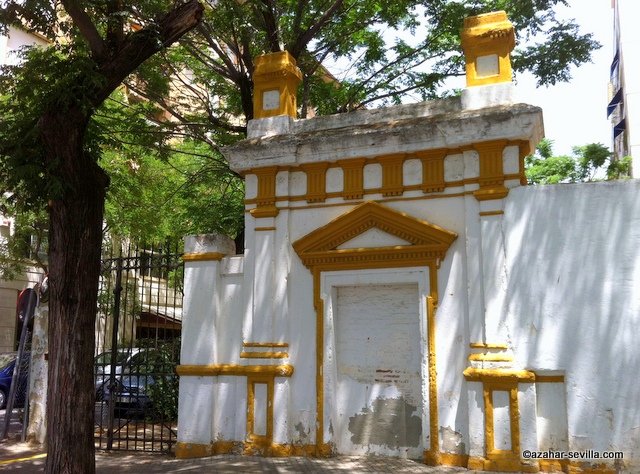
remaining gate of La Monumental

Halfway up Avenida Eduardo Dato, on the corner of Calle Diego Angulo Iñiguez opposite the Buhaira Palace Gardens, stands a short section of apparently functionless wall with a bricked up doorway to a small vacant lot. There’s no plaque, no sign, nothing to say that this is all that remains of the Plaza de Toros Monumental de Sevilla, the city’s ill-fated second bullring, first opened to the public in 1918, closed in 1921, and finally demolished in 1930. The driving force behind its construction was the famous bullfighter José Gómez Ortega ‘Gallito’, also known as Joselito, whose death in the ring on May 16, 1920, was a contributory factor in its closing. In 1915, when construction started, this was a ‘greenfield’ site a short way outside the city. Demolition made way for the new suburbs that now spread out to Nervion and beyond. I knew of the existence of the Monumental before I discovered this, but even such a small piece of its actual physical presence makes it much more real.

The architects were José Espiau y Muñoz and Francisco Urcola Lazcanotegui, whose other works include the Hotel Alfonso XIII, and the Adriática at the end of Avenida Constitución.

La Monumental tapas bar is located on the old site and is filled with bullfighting memorabilia including framed contemporary newsclippings about Seville’s forgotten bullring.

A Day Trip to Cádiz

A totally different way to beat the heat in Seville is to follow the Sevillanos and get outta town! One of my favourite summer day trips is to Cádiz on the Atlantic coast, one of the most picturesque cities in Spain, with a history that stretches back around three thousand years. Not only that, but if there’s any summer breeze going, Cádiz, on a headland surrounded on three sides by water, is the place to take advantage of it.

Although it has plenty of that quintessential Spanishness, Cádiz has a completely different feel to it than Seville. The streets are generally straighter and longer, and generally pedestrianized, and there are a number of “grand plazas” that give the city an air of nineteenth-century civic pride. My favourites are the contrasting pair of Plaza Mina, full of trees and ornamentation, and the wide open marble-paved Plaza San Antonio.

But that’s for later. My first stop after arriving is usually the Cathedral Plaza and my favourite pastry shop for some elevenses with a view. This is the oldest part of town, and apart from visiting the Cathedral, its worth going through the Arco de la Rosa and taking a stroll through the Barrio El Pópulo to the Roman amphitheatre, which was rediscovered entirely by accident in 1980.

The next stop has to be the central market, only recently returned to the renovated market hall, for a browse around the displays of fresh fish and fruit and veg so typical of Spanish markets. The area around it is always full of life, too, with little stalls selling flowers, jewellery. and all-sorts.

For me, the best way to see most of the city is simply to walk around its edge, taking whatever detours I need to see things that I want to. There’s plenty of those but there are a few that I always want to go back to no matter how many times I visit. Foremost of these is the brooding mass of San Sebastian castle, and the causeway that leads to it, although unfortunately, the castle itself is not open to the public. The best view is from another favourite place, La Caleta Beach, where you can check out the Balneario de la Palma, a “Victorian-style” beach spa, and have lunch at the beachfront restaurant there, watching the sun sparkling on the water and the little fishing boats bobbing on the waves.

Further on are the fortifications of Santa Catalina Castle, built to protect the city in the 17th century. The little turrets that you see dotted around the seafront are called baluartes, and are a distinctive feature of the city. Also here is the Parc Genovés, a botanical garden with many species brought over from the Americas. This is a fascinating place, with an artificial cataract and the strange topiary of the trees on the main path.

Now’s the time to visit those plazas, before ending the afternoon with a drink and a bit of people watching in the Plaza San Juan de Dios, opposite the old town hall. It’s a short walk to the train station from there and during the pleasant ride home I look forward to arriving back in Seville just in time to meet friends for an evening tapeo.