I bet you didn’t expect that! Okay, so I’m probably showing my age a bit, but I thought I’d start on a light note before delving into one of the darker aspects of the history of Spain and particularly of Seville.
The Tribunal of the Holy Office of the Holy Office of the Inquisition, to give it its proper title, was established in 1480 by the Catholic monarchs Ferdinand of Aragon and Isabella of Castile, whose marriage in 1469 had effectively unified Spain for the first time, shortly before the surrender of the last Moorish stronghold of Granada in 1492. As well as the Islamic Moors, Spain had for a thousand years played host to a large Jewish population, and the primary purpose of the Inquisition was to enforce the unification of the country through a rigid Catholic orthodoxy, although it also conducted investigations into blasphemy, clerical misconduct, and, occasionally, witchcraft. Although the numbers are not precise, it’s thought that between 3,000 and 5,000 people were put to death before the Inquisition was formally disbanded in 1834.
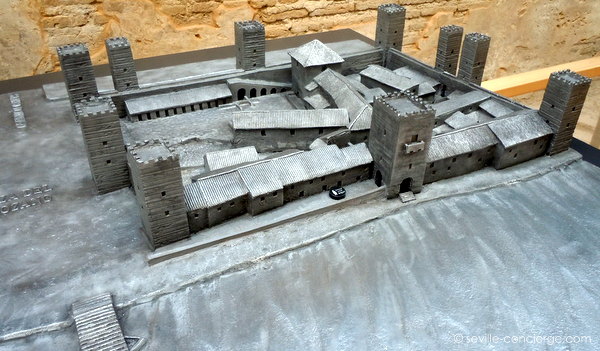
In Seville, the Inquisition almost immediately established it’s headquarters in the Castillo San Jorgé, whose ruins can now be seen below Triana market and house a Museum of Tolerance which is well worth a visit.
Plaza del Altozano s/n
Tel 954 332 240
Opening hours: Mon-Fri 11.00-18.30 / Sat-Sun 10.00-15.00
Entrance free
The castle itself is certainly much older than this, and was certainly already there in 1171, when the Moors built the “bridge of boats” where the Puente Isabella II (usually known as Triana Bridge) now stands.

The Inquisition’s first victims in Seville are closely connected to a well-known local folk-history, that of Susona ben-Suson (the basic story is history, the embellishments are various and not guaranteed). Susona was the daughter of a wealthy Jewish banker, who, as harrassment of the Jews mounted in the late 1470s, started meeting in secret with other influential local Jews. It’s not known for certain whether actual sedition was being planned, but Susona made the mistake of telling her Christian boyfriend about them, and he in turn reported it to the authorities. The group were duly summoned by the Inquisition and later executed. Overcome with remorse, Susona never again left her house, and when she died her head was hung outside, by her own command, as a warning to others, and in Calle Susona in the Barrio Santa Cruz, the street named after her, you can still find a small tile plaque of a skull on the wall.
 Although Father Christmas/Santa Claus has been gaining ground in recent years, in the south of Europe, and particularly the Spanish speaking world, the bringer-of-gifts is a much older figure, or more properly some much older figures, as there are three of them – the Three Wise Men of Biblical tradition, now more popularly known as Los Reyes Magos, the Magic Kings (Magos can be translated as either wizard or wise, and given that they “followed a star” they were probably astrologers). Although unnamed in the Bible, they have been popularly known since times immemorial as Melchior, Gaspar and Baltasar, and, despite the Pope’s recent assertion that they were Spanish, every Spanish child knows that they actually come one from each of the three continents, Melchior from Europe, Gaspar from Asia and Baltasar from Africa (no America or Australia in those days).
 Seville Concierge