Text by Peter Tatford
Photos by Shawn Hennessey
As all you erudite folks probably already know, Seville was in antiquity a Roman city, probably the most important in Western Europe outside of Italy itself. It’s official name from the time of Julius Caesar was “Julia Romana”, but as often happens it was the city’s older name, Hispalis, which remained in popular use, and is preserved in altered form in the modern name. It was an important trading, manufacturing and administrative centre with extensive commercial links with Rome, exporting wine, oil and fish products back to the Imperial capital.

But what was daily life like in Hispalis during the six centuries of Roman domination? Recently my friend Shawn @azaharSevilla and I were lucky enough to be invited to a rather special wine tasting event at Gastrosol, atop the Metropol Parasol. It was put on by the people responsible for Cotidiana Vitae (Daily Life) at Italica, the well-preserved Roman residential city at Santiponce, just outside Seville. Roman wines were provided by Baetica, who have done excellent work in recreating the styles of wines that would have been drunk in those far off times, drawing on the knowledge of winemakers, historians and archaeologists to make them as authentic as possible.
First though, it was down into the basement for a tour of the Roman ruins discovered when work to redevelop the site of the old market in Plaza Encarnación began back in the nineties. The ruins are now a well restored and preserved archaeology museum with some fascinating things to see. These include a fish salting plant that must have been a smelly neighbour for the residents, a house with an unusual (to me at least) raised platform for dining set into a semi-circular alcove, restored mosaics, and some crude gaming tables, as well as glimpses of the stratification (new bits built over old bits) of the site as it developed.

Then it was time to go upstairs for the wine tasting. Our hosts, Manuel León Béjar and Alejandro Vera had chosen four wines for us to sample, Mulsum (fermented with honey), Sanguis (steeped with rose petals), Antinoo (steeped with violets), and Mesalina (flavoured with cinnamon, and named for the wife of the Emperor Claudius), which became very popular in the later Roman Empire. It’s not really known how close these are to the Roman originals, especially as many of the old grape varieties have sadly disappeared, but extensive research into the wine making techniques of the time and descriptions of the grapes that were used gives us considerable confidence, and the use of the various flavourings is well attested to by writers and commentators of the time.
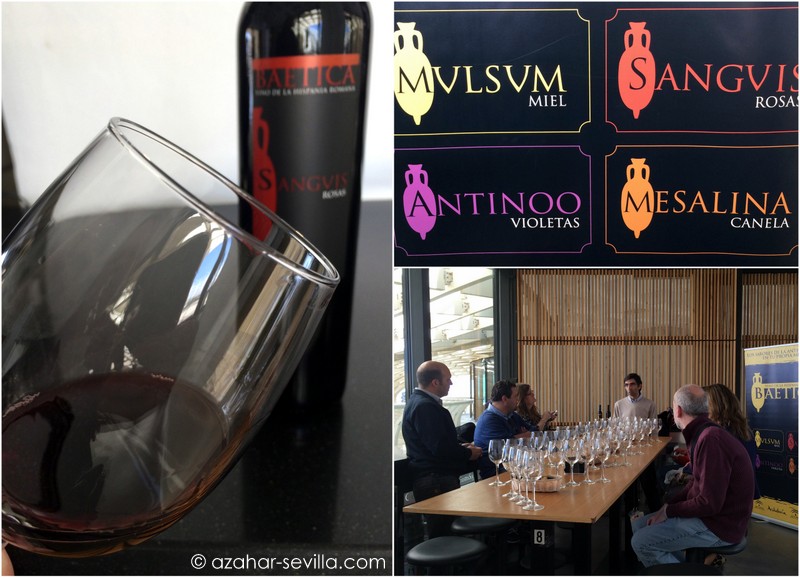
Now, I have to admit that I’m not really a wine expert, so for proper tasting notes and pairings I’m going to send you over to these good people (the notes are in Spanish), but I will say that it was a fascinating experience, and that the wines were quite distinctive compared to modern ones. My favourites were the Mulsum, which did have a definite tang of honey without being overly sweet, and the Mesalina, which was the most intensely flavoured, and was apparently mainly used at the end of, or even after, the meal. Maybe next time we’ll get a complete Roman banquet, though I’m still not convinced about the advantages of eating lying down.
For more information about activities at Italica, including tasting events, you can visit the Cotidiana Vitae website.
 Although Father Christmas/Santa Claus has been gaining ground in recent years, in the south of Europe, and particularly the Spanish speaking world, the bringer-of-gifts is a much older figure, or more properly some much older figures, as there are three of them – the Three Wise Men of Biblical tradition, now more popularly known as Los Reyes Magos, the Magic Kings (Magos can be translated as either wizard or wise, and given that they “followed a star” they were probably astrologers). Although unnamed in the Bible, they have been popularly known since times immemorial as Melchior, Gaspar and Baltasar, and, despite the Pope’s recent assertion that they were Spanish, every Spanish child knows that they actually come one from each of the three continents, Melchior from Europe, Gaspar from Asia and Baltasar from Africa (no America or Australia in those days).
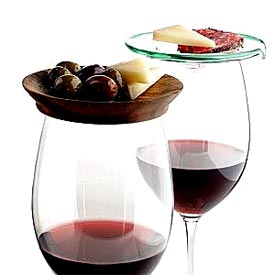 The first of these questions is relatively simple. In Spanish a “tapa” is a lid or cover, and the story is that tavern keepers would give their customers a slice of bread or ham to cover their drinks to keep out the dust and the flies (fruit flies are partial to a bit of sweet wine or sherry). It’s also possible that something strongly flavoured, like cheese, could be used to disguise the taste of poor quality wine.
 This is also a tale of three kings (but not The Three Kings). It is said that when the 13th century king Alfonso X “The Wise” became gravely ill his recovery was aided by eating small quantities of food and drink throughout the day, instead of full meals, while Felipe III in the early 17th century decreed that tavern keepers had to serve food with their drinks as a measure to combat the problem of drunkenness, especially among off duty soldiers and sailors. Later Alfonso XII (or possibly Alfonso XIII, an indication that the story may be apocryphal) is claimed to have been visiting a tavern in Cádiz and was served his drink with a slice of ham to keep out the sand blowing in from the beach. When he ordered another drink he asked for it with “the cover”. Over time the food that was served became more varied and more substantial, and going out for tapas became a common practice. The activity is also a very social one, and families and groups of friends would share their tapas while socialising, making this a very convivial activity in a way that is unusual for a more formal meal.
 As the observant visitor to Seville will quickly notice, the day here has a different rhythm from what’s typical in either North America or the countries of Northern Europe. Most of the shops close for the afternoon, and then open again late into the evening, and the streets start to fill with people just when the guiris (foreigners) are heading home to bed. A lot of this has to do with the weather, of course. In summer (basically from April to October) it makes good sense to be out and about in the cool of the morning and the cool of the evening, and the consequent short nights and the afternoon heat means you really need that afternoon siesta.
 The main meal of the day is lunch (almuerzo), usually eaten between 2.00 and 4.00 pm. For working people who have to eat lunch out on a regular basis most tapas bars have a menu del día (a daily special), a two or three course meal with several options and usually including bread and a drink, costing between 6.50 and 12 euros. Don’t confuse the menu and the carta (main menu).
 Seville Concierge