The Footsteps of Saint Teresa of Ávila in Seville

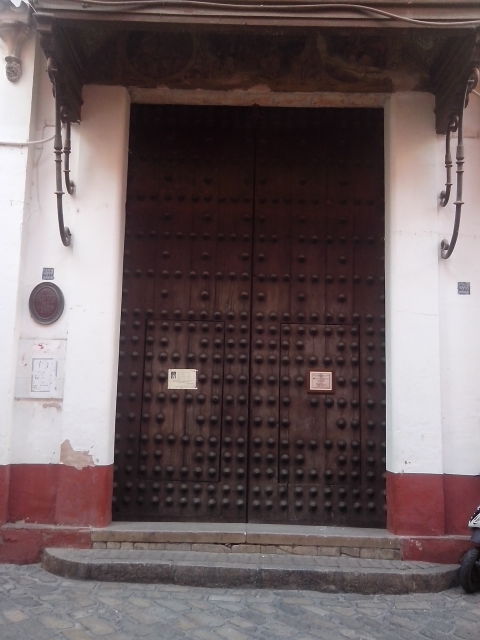
Entrance to Las Teresas convent

In the heart of the Santa Cruz neighbourhood of Seville, leading up from the Plaza Santa Cruz towards the cathedral, is the little winding street of Las Teresas. If you live in Seville, or have visited as a tourist, you will certainly have walked along it. You will quite likely also have stopped in at its best-known landmark, the delightful Bar Las Teresas, with its rows of jamón Iberico hanging from the ceiling. But diverting though it is, this is not our topic for the day and reason for being here, which is across the street and a couple of doors down. Here you will find yourself in front of a truly impressive wooden door in an ornate portal set in a rather blank and forbidding wall, with just a few barred windows set high up near the roof. It’s the entrance to the Convent of San José, better known as Las Teresas after its founder Saint Theresa of Ávila.

Santa Teresa is one of the Catholic Church’s most prominent saints and theologians, a mystic, writer and reformer of the Carmelite nuns, and the current interest in her is because next year is the 500th anniversary of her birth.

She was born in 1515 in Ävila, a small town between Madrid and Salamanca most famous for its virtually intact city wall. Her grandfather had been a Jewish convert to Christianity, and had been investigated by the Spanish Inquisition for allegedly returning to the Jewish faith (remember that the last of the Moors had only been expelled from Granada in 1492, and Christianization of the newly created kingdom of Spain set in motion by Ferdinand and Isabela). Her father, however, had successfully integrated into the new order, and Teresa’s mother was a pious Christian who read Teresa stories from the lives of the saints as a child. After her mother died, when Teresa was 14, she developed a romanticised and sentimental obsession with the Virgin Mary and works of popular fiction about mediaeval knights.

Not long afterwards she was sent to be educated by the Augustinian nuns of Ávila, after which, now aged 20, she entered the Carmelite Monastary of the Incarnation, an order enjoined to contemplation and devotion, supposedly founded on Mt Carmel in the 12th century. It was here in the quiet of the cloister that she experienced the ecstatic religious trances for which she is most famous, and developed the mysticism which was her inspiration. At the same time she became increasingly concerned by the lax observance of the Carmelite order in Ávila, and despite some initial opposition set up a reformed Carmelite (the discalced, or barefoot Carmelites) convent in Ávila, the beginning of twenty years of reform and founding of new convents which bring us back again to the starting point of our article.

On May 26, 1575, Teresa arrived in Seville with a few nuns, for the purpose of founding a convent (her eleventh). To begin with they rented a house on Calle Zaragoza, where they stayed for ten years, but the location was never satisfactory. In those days (Seville’s Golden Age at the height of the America’s trade) Zaragoza was one of the main streets leading down to the port, a noisy place full of taverns, sailors and traders. Eventually, with the help of San Juan de la Cruz (Saint John of the Cross), they were able to buy the property in Teresas Street which has been their home ever since. Although not open to the public, it included among its possessions the only known portrait of Teresa painted during her lifetime, and the original manuscript of her best known work, Las Moradas, the Dwellings of the Interior Castle.

Teresa herself never saw the order’s new home. In 1582 while travelling in northern Spain she was taken ill and died. By one of those strange quirks of fate or history she died on the night when the Church was switching from the Julian to the Gregorian calendar, with the removal of the dates October 5-14 that year. Teresa died either late in the evening of October 4 (Julian), or in the early hours of October 15 (Gregorian). She was beatified in 1614 and canonized in 1622, and remains one of the Catholic church’s most popular and important saints.

Roman Wine Tasting

Text by Peter Tatford
Photos by Shawn Hennessey

As all you erudite folks probably already know, Seville was in antiquity a Roman city, probably the most important in Western Europe outside of Italy itself. It’s official name from the time of Julius Caesar was “Julia Romana”, but as often happens it was the city’s older name, Hispalis, which remained in popular use, and is preserved in altered form in the modern name. It was an important trading, manufacturing and administrative centre with extensive commercial links with Rome, exporting wine, oil and fish products back to the Imperial capital.

baetica wines

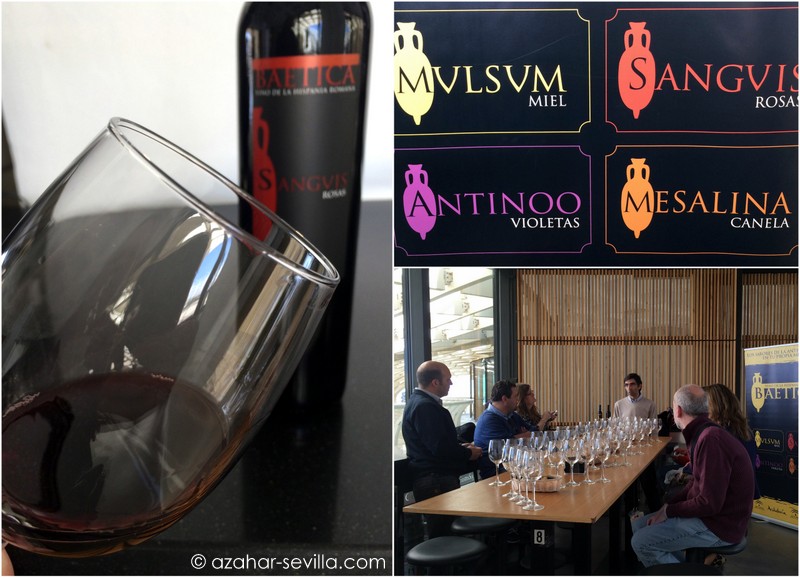
But what was daily life like in Hispalis during the six centuries of Roman domination? Recently my friend Shawn @azaharSevilla and I were lucky enough to be invited to a rather special wine tasting event at Gastrosol, atop the Metropol Parasol. It was put on by the people responsible for Cotidiana Vitae (Daily Life) at Italica, the well-preserved Roman residential city at Santiponce, just outside Seville. Roman wines were provided by Baetica, who have done excellent work in recreating the styles of wines that would have been drunk in those far off times, drawing on the knowledge of winemakers, historians and archaeologists to make them as authentic as possible.

First though, it was down into the basement for a tour of the Roman ruins discovered when work to redevelop the site of the old market in Plaza Encarnación began back in the nineties. The ruins are now a well restored and preserved archaeology museum with some fascinating things to see. These include a fish salting plant that must have been a smelly neighbour for the residents, a house with an unusual (to me at least) raised platform for dining set into a semi-circular alcove, restored mosaics, and some crude gaming tables, as well as glimpses of the stratification (new bits built over old bits) of the site as it developed.

antequarium tour

Then it was time to go upstairs for the wine tasting. Our hosts, Manuel León Béjar and Alejandro Vera had chosen four wines for us to sample, Mulsum (fermented with honey), Sanguis (steeped with rose petals), Antinoo (steeped with violets), and Mesalina (flavoured with cinnamon, and named for the wife of the Emperor Claudius), which became very popular in the later Roman Empire. It’s not really known how close these are to the Roman originals, especially as many of the old grape varieties have sadly disappeared, but extensive research into the wine making techniques of the time and descriptions of the grapes that were used gives us considerable confidence, and the use of the various flavourings is well attested to by writers and commentators of the time.

roman wine tasting

Now, I have to admit that I’m not really a wine expert, so for proper tasting notes and pairings I’m going to send you over to these good people (the notes are in Spanish), but I will say that it was a fascinating experience, and that the wines were quite distinctive compared to modern ones. My favourites were the Mulsum, which did have a definite tang of honey without being overly sweet, and the Mesalina, which was the most intensely flavoured, and was apparently mainly used at the end of, or even after, the meal. Maybe next time we’ll get a complete Roman banquet, though I’m still not convinced about the advantages of eating lying down.

For more information about activities at Italica, including tasting events, you can visit the Cotidiana Vitae website.

The Queen’s Sewing Box

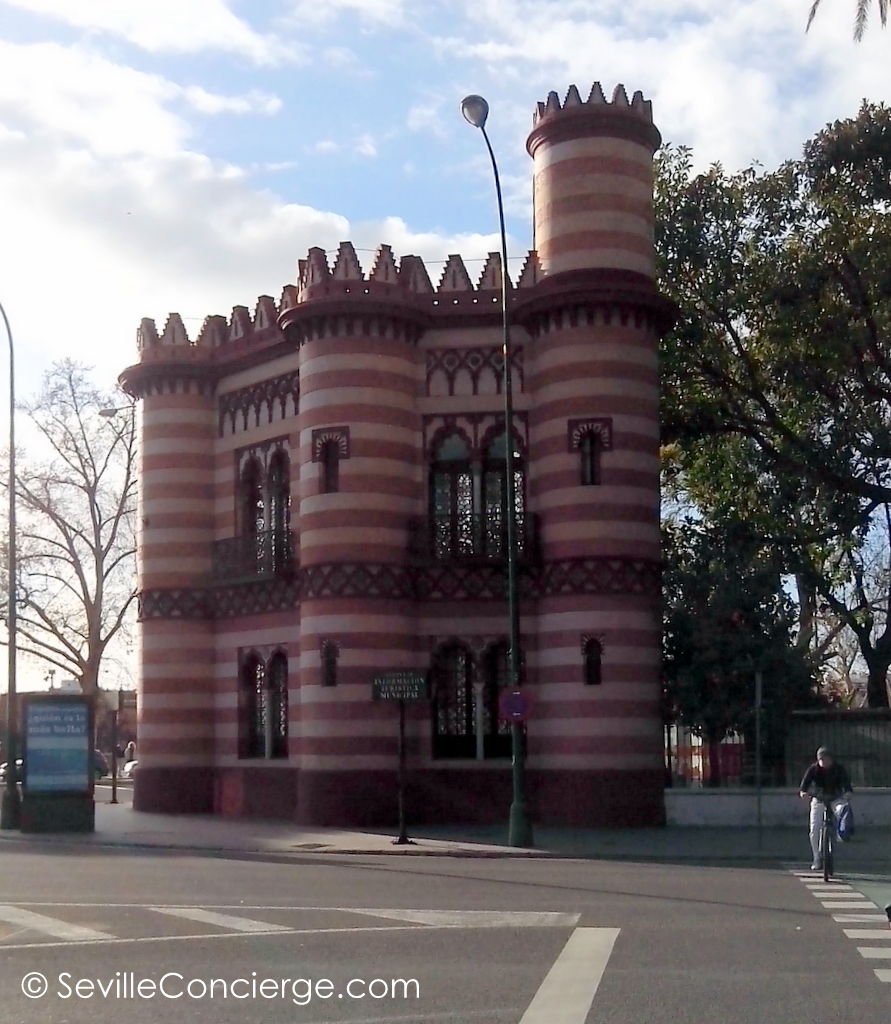
queens sewing boxPretty much everybody who comes to Seville has the Plaza España in Maria Luisa Park on their list of places to see, and rightly so. But here’s a suggestion for something a little different to look at on your way back to the city. Just outside the park proper, across the main road from the Los Remedios Bridge, is an almost fairytale little building decorated with horizontal stripes that always remind me of a wedding cake, and topped with crenellations and a miniature watchtower. It’s popularly known, for historically inaccurate reasons, as the “Queens Sewing Box”, and for this reason has become  attached to a rather poignant story.

Considered to be the first building in the Neomudejar style that was to be so popular during the first three decades of the 20th century, it was built in 1893 by the architect Juan Talavera de Vega as a guardhouse and garden retreat in the grounds of the San Telmo Palace. The palace itself can be found just before the next bridge upriver, an impressive building built in 1682 as the School for Navigators, that’s architecturally one of the most important of the 17th century. This palace and its very extensive grounds were eventually acquired by the Duke of Montpensier, a French aristocrat, and his wife the Spanish Infanta Fernanda Luisa in 1849. Their daughter, Doña Maria de las Mercedes of Orleans, was born in 1860.

san telmoIt was a troubled period in Spanish history. In 1868 Queen Isabella II was deposed, and Mercedes’ family went into exile, not returning until the restoration of Alfonso XII in 1874. Mercedes and the new king, who was also her cousin, had met in 1872, and on January 23, 1878 the couple were married. It soon became obvious that the new queen was sick, in fact with typhoid fever, and on June 26, at the age of 18, and after just five months of marriage, she passed away.

Quite why the popular tradition should have grown up that because of her delicate health this queen spent much of her time here sewing is unclear, but the name has stuck, and this little building will always be “The Queen´s Sewing Box”.

When the Infanta Luisa died in 1897, most of the gardens of San Telmo Palace were gifted to the city and became the site of the 1929 Spanish American exhibition, now Maria Luisa Park. The Queens Sewing Box is a tourist information centre with a small exhibition and cafe upstairs.

The Legend of Sierpes

Calle Sierpes (Serpent Street) is the main shopping and commercial street through the centre of Seville, connecting Plaza San Francisco and the Town Hall at one end with the Plazas Campana and Del Duque at the other, and it’s one of those streets whose name is almost synonymous with the city where it is to be found. This relationship is a product of the many literary references to the street, most notably in the works of Cervantes (who for a short period was “a guest of his majesty” in the Royal Prison, which once occupied the site of the Cajasol bank on the corner of Sierpes and Entrecarceles streets).

During Seville’s Golden Age (the 16th century, following Columbus’ discovery of America) Sierpes was notorious for the shady characters who gathered there, intent on making easy money from the riches generated by the trade with the new World.

In early mediaeval times the area lay outside the city wall, and a branch of the Guadalquivir flowed through what are now the Alameda de Hercules, Trajano, Sierpes and Constitución (a Viking longboat was discovered beneath the Plaza Nueva), most of which was drained to make way for the expansion of the Moorish city in the 11th century. One theory as to the origin of the name Sierpes is that it’s because the street follows the winding, serpentine course of this old river.

In the 15th century it was known as Espaderos (Swordsmith) street, for the great number of workshops of this type, only acquiring the name Sierpes afterwards, for reasons that are disputed. Apart from its winding course, the name may be derived from the Locksmith’s Cross, the Cruz Cerrajería, that once stood there, but is to be found today in the Plaza de Santa Cruz, which is embellished with snake-shaped ornaments. It is also said that it is named for one Alvaro Gil of Wurms, who had his residence here, or for a tavern called Wurm. Most popular, though probably not the most truthful, is the Legend of the Serpent.

It is said that in the late fifteenth century children in the neighbourhood began to mysteriously disappear without trace. After months of anxiety, a man who would not give his name promised to solve the mystery and identify the culprit, but only if his request to be released from prison was granted. Alfonso Cardenas, the ruler of the city at this time, accepted the terms, and sent his clerk to get the details.

The anonymous informant was one Argüeso Melchor de Quintana, a Bachelor of Arts from the University of Osuna, in prison for participating in a rebellion against the king inspired by the Duke of Arcos, who had later deserted him. Before the notary Quintana recounted how he had found the culprit. He had made a tunnel in order to escape from the prison, and stumbled on the Roman and Muslim underground galleries of Seville. In his flight, he ran into the child stealer, who he had killed before returning to jail because he did not want to spend the rest of his life as a fugitive. He then took them to the place, where they found the murderer already dead, with a dagger buried in him to the hilt, and the bones of the children around him. But the culprit was not a man, but a huge snake, which was presented to the public in Espaderos street, which thereafter was also known as “Calle de la Sierpe “. Quintera obtained his promised freedom, settled in Seville and married the daughter of Cardenas.

The Lost Rivers of Seville

I’ve long had a fascination with those bits of a place that have been lost and largely forgotten, such as Seville’s second bullring, and one aspect of this in urban areas is the old watercourses that have been buried or diverted, and disappeared from view. My interest began in London, with rivers like the Fleet, the Walbrook, the Lad Brook and the West Bourne, and has continued now that I live in Seville.

The city of Seville is on the banks of the River Guadalquivir, and although the valley is quite wide and flat, there are uplands not too far away from which streams drain into the main river.

Indeed, the main river itself has seen substantial changes since the beginning of the 20th century. Before that time the areas of Seville near the river had been subject to frequent, and sometimes severe, flooding, the result of snow melt in the mountains above Córdoba and the winter rains. In addition to this the old port on either side of the Torre del Oro had become silted up, and inaccessible to modern commercial shipping. This resulted in an ambitious project to deal with both these problems.

It can be seen on old prints and paintings that just below the old city the river followed a big looping curve to the right (west) of its present course. In the early 20th century a completely new artificial channel was created that cut off the loop, and allowed the modern port of Seville to be built. Later, another new channel was cut to the west of Triana that takes the main flow of the Guadalquivir (the last stage of these works was completed around 1990 for the expo of ’92). The river that you see now by the old city is therefore the original course, but it no longer connects to the new river at its inland end, preventing floods in the city centre. Perhaps most surprisingly, the site of the April Fair is built on land reclaimed from the old course of the river.

Although it’s difficult to visualise now, there was also a second channel beside the main river that ran from near the Barqueta Bridge, through what is now the Alameda de Hercules, along Sierpes and Constitución to near the Torre del Oro. The Vikings used this route to attack the city in the 9th century (one of their longboats was discovered beneath the Plaza Nueva), but most of it was drained when the city was expanded in the 11th century. The northern section, however, remained as a stagnant lagoon until the 16th century, when it was cleared and drained to create the Alameda de Hercules. A small stream whose be springs fed the water cisterns under the Plaza de Los Pescadores, and which can still seen in the crypts beneath El Salvador church, also ran here.

The last of our lost rivers is the Tagarete. This ran around the east and south of the city, just outside the walls, and though its course was diverted to the north of the city in the 20th century the small culvert where it joined the Guadalquivir can still be seen near the Torre del Oro. Also still visible are the culverts that fed the moat around the Royal Tobacco Factory. Sometimes a substantial stream, and sometimes almost dry, depending on the season and the rains, it was often noxious and polluted, as it ran past both the mediaeval tanneries and the slaughterhouses outside the Puerta de la Carne.

Nowadays there is almost nothing to show where these rivers ran, although if you know where to look in the layout of the streets, with a little imagination you can almost see them as they were, and how the city itself might have appeared in those bygone days.

Three Palaces

In the glory days of the empire, Spanish society was dominated by a rich, ruthless aristocracy that was totally convinced of its own right to rule, and Seville, the richest city in Europe, boasted dozens of palaces and grand houses.

Although some of these no longer exist, many are still with us, though often much changed in use and appearance. What were once the houses of the wealthy are now often smart hotels (the classic construction of rooms surrounding one or more central courtyards makes them ideal for the purpose), or have been converted into private apartments.

Some, however, not only still exist, but are also still the private homes of some of Spain’s top aristocratic families. So here are three palaces that you can see (though only from the outside) in the centre of Seville still occupied by the titled and (presumably) wealthy.

The first, the Palace of the Marquises of La Motilla, is certainly the most visible, being right in the city centre on the corner of Calle Laraña and Calle Cuna, though it might be considered cheating a little as the building we see today was only constructed in the early 1920s when these streets were widened. It’s most obvious features are the square 25-metre-tall watchtower, its neogothic arched windows, and the courtyard trees behind the corner of the building. Not what you expect in the middle of a shopping street, but Seville is good at surprises.

Our second palace is in the heart of the Barrio Santa Cruz, in the Calle Lope Rueda, just off the Plaza Alfaro, where the front door of the Palace of the Marquises of Pickman is set back from the street behind a short iron fence. And it’s quite some front door. The elaborate facade (in a style known as plateresque) is not only big, it was also moved here from another palace in Ubeda and re-erected. The Pickmans themselves, as you might guess from the name, are not of Spanish descent, but were a merchant family from England who in the 19th century owned the successful ceramics and pottery factory in the Cartuja monastery.

Our third palace is the home of the best-known of our aristocrats, the 87-year-old Duchess of Alba, Spain’s most titled peer and a personal friend of Prince Charles and Camilla Parker-Bowles. The Palacio de Las Dueñas can be found near the city centre in the Macarena neighbourhood behind a large, but not overly ostentatious, gateway in Calle Dueñas, which gives you a good view across the gardens to the house itself. The house wass also the birthplace of Antonio Machado, one of Spain’s most famous poets, whose father was employed in the house.

A Night Tour of El Salvador Church

salvador night visit (1)

If you buy an entrance ticket to Seville’s famous Cathedral, you’ll have the option of a combined ticket that also allows you into the nearby church of El Salvador, the second biggest in Seville after the Cathedral itself. Although not as grand as its big sister, it is nevertheless impressive, both from outside in the Plaza, and from inside, where one is almost surrounded by the huge, ornate shrines and altarpieces, but for me the most interesting things about it are the things that you usually can’t see. For although the present building was only completed in 1712, the site has been in use since antiquity, and beneath its floor is a “layer-cake” of the history of Seville, stretching back through the late Mediaeval period, the Grand Mosque of the Islamic period and the Visigothic church, to the time of the Romans, when the basilica, the most important public civic building in a Roman city, stood on this spot. Over the last ten years extensive restoration work in the crypts has revealed many interesting things related to that past, and I was recently fortunate enough to take part in one of a season of night tours that have given members of the general public the opportunity to learn more about this unique heritage.

The tour gathered in the patio, where you can already see the tops of the original Moorish pillars and arches, and also the old minaret, now a bell-tower, before our guide led us down into the crypts. These proved to be surprisingly un-creepy, as the renovation work had included modern lighting and air-conditioning as well as structural supports for the pillars of the church above us, and we were able to see some of the tiled floors from the mediaeval period (the floor of the present church having been built above these), preserved Roman and Arabic inscriptions, and the alcoves where many hundreds of people, often children, had been buried through the centuries. At the very lowest point we saw the buried stream that had been the source of the problems that had led to the necessity for works beneath the church.

salvador night visit (2)We then had the unusual experience of going into the chamber (the camarín) behind the seated statue of the church’s patroness, the Virgin of the Waters. This can be glimpsed from outside the church through the window where she is placed to watch the Semana Santa processions.

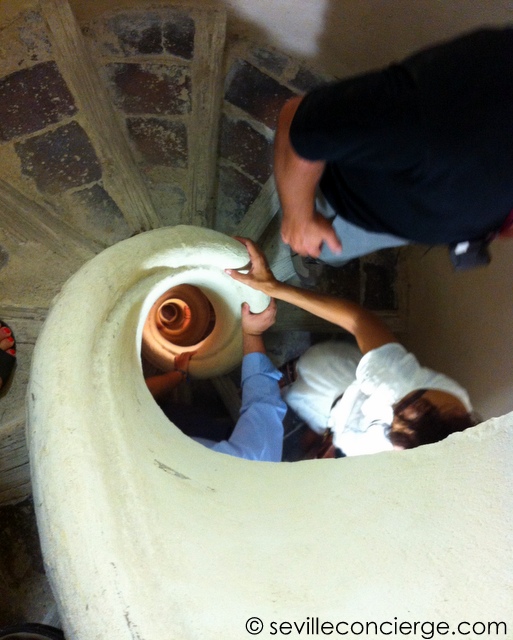
The final stage of the tour took us upwards, by way of one those cramped, tightly curved spiral staircases, first to the balconies inside the church, and then onto the roof. I don’t have much of a head for heights, but the view over the surrounding streets as we did a complete circuit before descending to ground level again was incredible.

All in all it was a really interesting and unusual experience, and I would urge anyone who has the opportunity to do this tour not to miss it. The guided night tours (in Spanish) cost 12 euros with a minimum group of 10 people and are available until September 15th (the day tours are available year round). For more information go to the Cathedral Reservations Page.

Festival of the Virgen de Los Reyes

I’ve said it before, but I’ll say it again – Seville is big on Virgins. And on August 15 it’s the turn of Seville’s very own Our Lady the Virgin of the Kings, the official patroness of the city.

The stories of the origins of the image, whose actual sculptor is unknown, are a mix of history and legend. According to some she was carved by the angels and after being found by Ferdinand III, accompanied him throughout the reconquest of this part of Spain from the Moors. More prosaically, it is said that the king saw her in a vision, and that the image was made on his orders. Another story is that she was a gift from Ferdinand’s cousin, Louis IX of France. Since the 16th century she has “lived” in the Royal Chapel in the Cathedral.

The celebrations officially extend from August 4 to 22, with special services in the cathedral and viewing of the Virgin, but the highlight is the triumphal procession on August 15, the day of the Ascension of the Virgin Mary. The route is short, the procession leaving the cathedral by the gate in the plaza, and doing a single anti-clockwise circuit of the cathedral before entering again by the same gate. It starts early, too, at around 8am, but it’s worth missing your lie-in to go and watch.

The procession is accompanied by many local church and civic dignitaries, a brass band, the pealing of the church bells, and large crowds in the square and surrounding streets. Nowhere does religious processions better than Seville, and the procession of the city’s patron Saint is no exception.

Three Icons

Three Icons

Pretty much wherever you go in Seville, or in whatever you read about the city, the images of three of its buildingsare inescapable. They appear on postcards, as souvenirs, or decorating the walls of shops, bars and other public places, and have become enduring symbols of the city.

The Giralda Tower

giralda tower at night

The most famous of these buildings is undoubtedly the Giralda, now the bell tower of Seville cathedral, but originally the minaret of the Grand Mosque that occupied the site in the time of the Moors. The tower was built between 1184 and 1198 by the architect Ahmad Ben Baso, and is similar to other famous minarets in Rabat and Marrakech. There are also a number of copies of the tower in the United States, most notably in Kansas City.

The top of the original tower was immediately below where the bells are today, and was surmounted by four copper spheres, but these were lost in the earthquake of 1365, and replaced by a cross and bell. The bell tower and the weather vane that gives the tower its name (girar is Spanish for turn) were added in 1568, making it 104 metres tall.

Inside, the tower is climbed by way of a ramp, rather than stairs, (the muezzin used to ride his donkey to the top to call the faithful to prayer) and whatever else you do in Seville you have to go up and enjoy the view over the rooftops of the city.

The Torre del Oro

torre del oroThat the second of Seville’s visual icons, the Torre del Oro (Gold Tower) also dates from late Moorish times is a testament to the importance of this period to the cultural development of the city. The distinctive twelve-sided tower was originally built as part of the city’s defensive system along the Guadalquivir river, when Christian forces began to seriously threaten the Islamic heartland of al-Andalus in the early 13th century, but failed to prevent the city falling to Ferdinand III in 1248.
It’s thought that it got its name from the golden glow of its reflection on the river, though another theory says it was because the tower was used to store gold offloaded from the ships returning from the Americas.

It has survived being used as a gunpowder store, and proposals by the city council to have it demolished. Nowadays it houses a small naval museum, whose entrance, now at road level, could once only be reached by a walkway over an arch whose far end can still be seen just inside the building on the opposite side of the street.

Plaza España

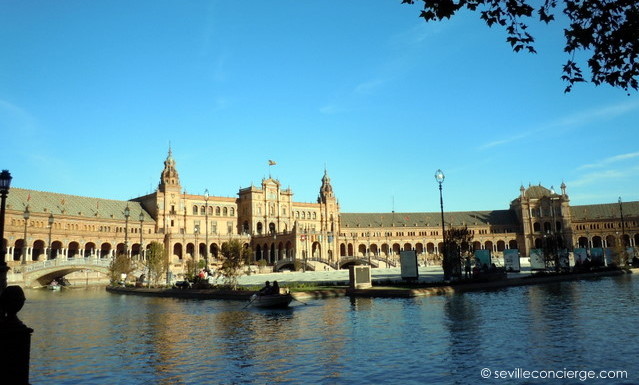
The Plaza España, in Maria Luisa Park, was built as the centrepiece of the 1929 Spanish-American exhibition, and is the masterwork of the architect Anibal González. The plaza with its central fountain and the huge semi-circular facade of the pavilion are instantly recognizable from thousands of postcard pictures, photographs, and films such as Star Wars: Attack of the Clones, Lawrence of Arabia and The Dictator.

plaza espana

Below the long colonnaded walkway are the alcoves with representations in ceramic tiles of historical scenes from each of Spain’s provinces, and at each end are almost disneyesque towers (unfortunately these are not open to the public to climb, as they would give great views across the park). There is also a boating “lake” spanned by four bridges that lead from the central plaza to the pavilion, and everything is decorated with a profusion of colourful ceramics.

Seville Modern

There are lots of reasons why people choose to come to Seville for a holiday. There’s the sunshine and bright blue skies. There’s the orange trees, especially the heavenly scent of the blossom, and the vibrant colours of the city’s parks and gardens. There’s flamenco, the Spring fair, and the Holy week (and other) processions, and plenty of art and culture. Then there’s the food – the culinary and social phenomenon that is tapas, which is becoming increasingly well-known, and is beginning to be exported to other parts of the world. And, of course, Seville is almost over-endowed with history and historical monuments and the picturesque narrow streets of the old neighbourhoods of the centre of the city.

But as well as all this, Seville is not just a giant postcard, but a place where people live and work, and where the new has to be continuously integrated with the old. This is nothing new. In the tens and twenties the preparation for the 1929 Spanish-American Exhibition involved en extensive programme of urban renewal and renovation, and the 1992 expo (celebrating the 500th anniversary of Columbus’s discovery of America) left its mark on the riverside and the Cartuja skyline. But the real challenge is not building new things, it’s building new things that fit in with what’s there already, and don’t stand out like a sore thumb.

Despite the occassional hiccup, Seville has generally met this challenge remarkably well, and for me there are two examples that everyone should see. The first of these you will certainly find for yourself, as it’s right alongside the World Heritage Centre of the Cathedral, Archivos de India and Alcázar Palace. In some ways, however, it’s quite mundane, and it’s possible you won’t “see” it. I’m talking about the Avenida de la Constitución, the main street that runs in front of the cathedral, and its extension into Calle San Fernando. The first impression is of a classic modern European avenue, with a sleek new tram system and pavement cafés, lined with the ubiquitous Seville orange trees. But look around and you can see the old Seville alongside the new. Here are the Cathedral (15th century), the Archivos de India (17th century), the Tobacco Factory (18th century), and a number of neo-Mudejar style buildings of the early 20th century, all living together as if part of a single grand design.

The second example is a new building. The Metropol Parasols (or The Mushrooms as they are known locally) were completed just two years ago, and are the world’s biggest wooden structure (although Colossos comes pretty close). This fantastical, almost ultra-modern edifice swoops and curves above the Plaza de la Encarnación in the city centre, and houses Roman ruins, a provisions market, and up on the roof a complex of bars and walkways with stunning views. Naturally, it’s been controversial, but I like to think that the modern builders were moved by the same spirit that moved one of the creators of the Cathedral, who said “Let us build a cathedral so immense that everyone on beholding it will take us for madmen.”